
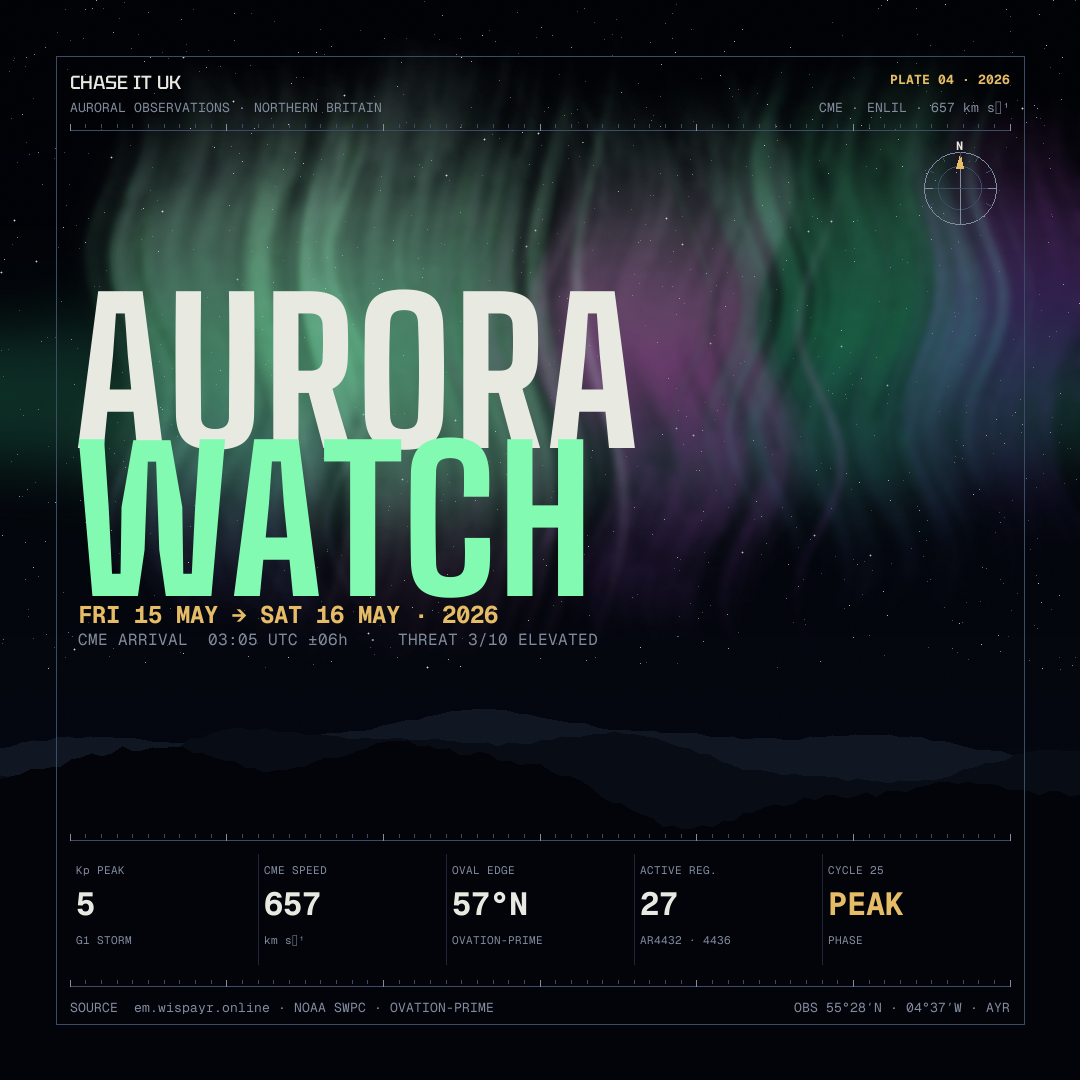
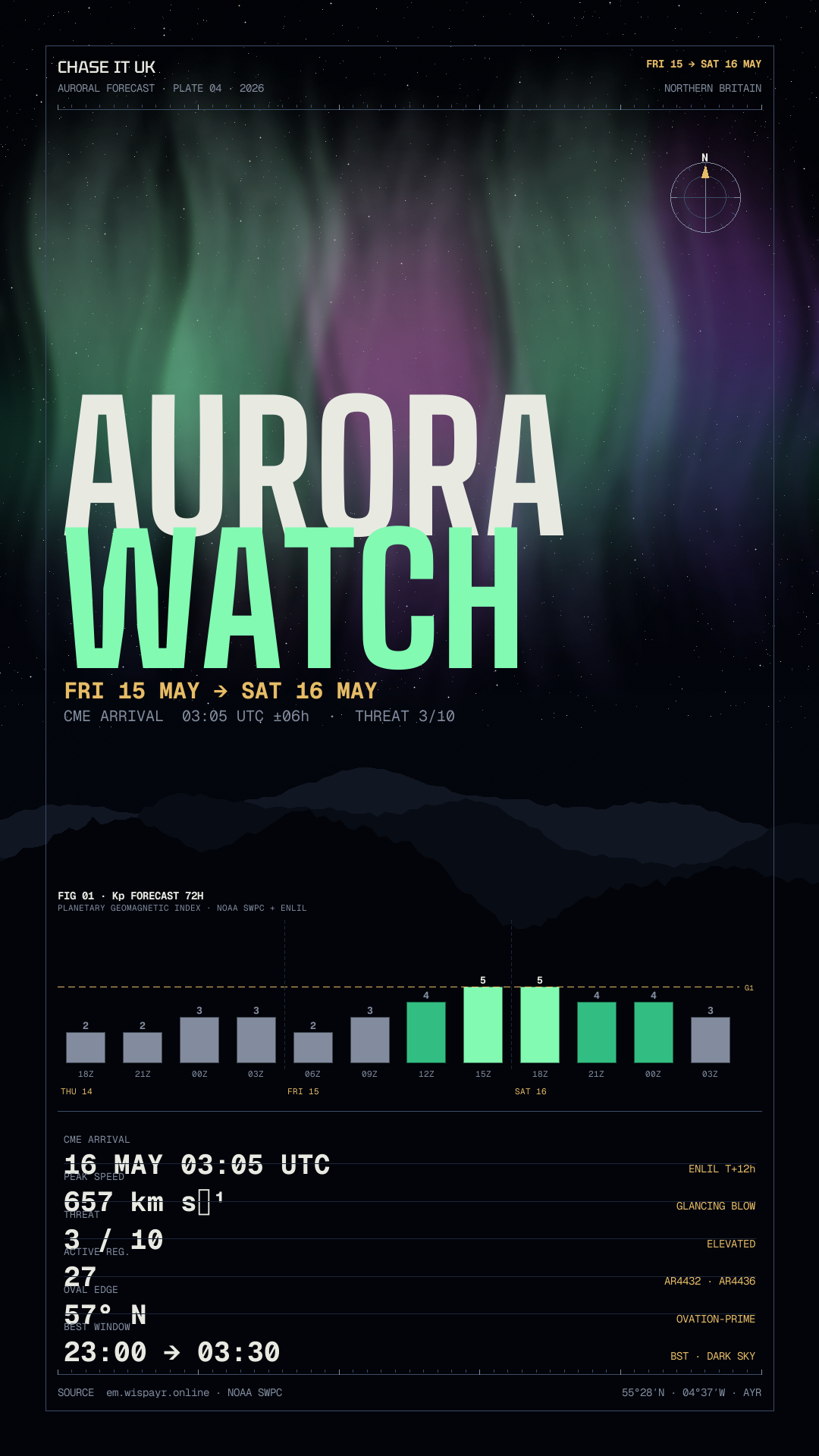
Big solar week. NOAA's Enlil ensemble has a CME cloud arriving around Friday night into Saturday morning, 15–16 May, peak speed roughly 657 km s⁻¹. Current threat score sits at 3/10 — elevated. It's not a direct hit, so think glancing chance, not a guaranteed show.
If conditions cooperate, the auroral oval edge could push down to the high 50s°N — within reach for northern Scotland, the Highlands, and possibly as far south as the Borders given clear sky and dark horizon.
The setup
The sun's been busy. There are 27 active sunspot regions on the visible disk, including two worth watching:
- AR4432 sits west of the central meridian with a 75% C-class and 25% M-class flare probability over the next 24h. Not earth-directed any longer, but it has thrown CMEs already.
- AR4436 is rotating onto the earth-facing side from the east limb — a region that could become more relevant later in the week.
The actual driver this weekend is the CME currently in flight. Enlil's ensemble shows the cloud crossing 1 AU near 03:05 UTC on Saturday 16 May, with a ±6h uncertainty window. The model error is the main reason we're calling this a watch rather than a go.
What to watch for
- Kp index climbing through 4 → 5+ would push the oval into Scottish skies. We're forecasting peak around Kp 5 (G1 storm). Anything above that is a bonus.
- Bz southward sustained for 30+ minutes — when the interplanetary magnetic field tips south for that long, the geomagnetic coupling really kicks in. The live aurora dashboard shows this directly.
- Dst dropping below about -50 nT is a strong corroborating signal.
Best window
If the timing holds, the best viewing window is roughly 23:00 BST Friday → 03:30 BST Saturday. Far north Scotland sees genuine dark sky in this window; further south you'll need to be away from city light pollution.
Field kit reminder
- Get well away from sodium lights. The aurora is dim — even a Kp 5 event from southern UK is more of a green glow than the postcard ribbons you see from Tromsø.
- Point your camera north and shoot long exposures (5–15 s, ISO 1600–3200, f/2.8 or wider). Phones with night mode pick up much more than the naked eye — don't dismiss what looks like a grey-green smudge until you've taken a frame.
- Cloud cover is the only thing that matters once the geomagnetic conditions are met. Check the outlook the evening of, not three days out.
- AuroraWatch UK and SpaceWeatherLive both run free alert services worth setting up.
Sources
This advisory is cross-checked against the live observatory at em.wispayr.online, which fuses NOAA SWPC (Enlil + OVATION-Prime), GOES X-ray, ACE/DSCOVR solar wind, and ground magnetometers into a single readout. The chaseit live aurora dashboard is the operational view — refresh that the evening of, not this post.
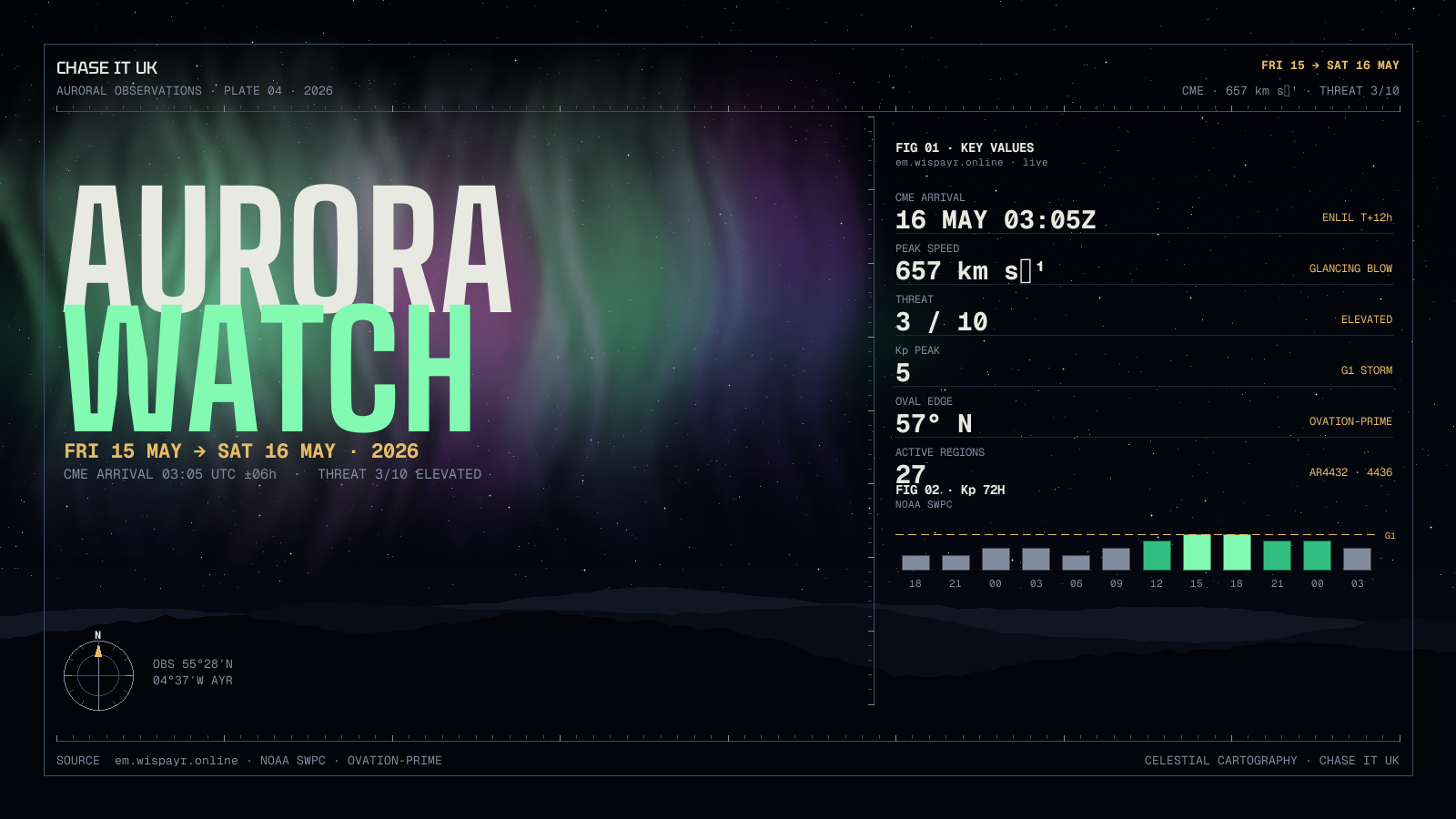
We'll update this post if the model shifts. The CME arrival window is the largest single source of uncertainty, and Enlil has a habit of revising its arrival time by ±6h as the cloud crosses L1.
Discussion · 0
Sign in to commentNo comments yet — be the first.
Members can post. Sign in to join the discussion.